
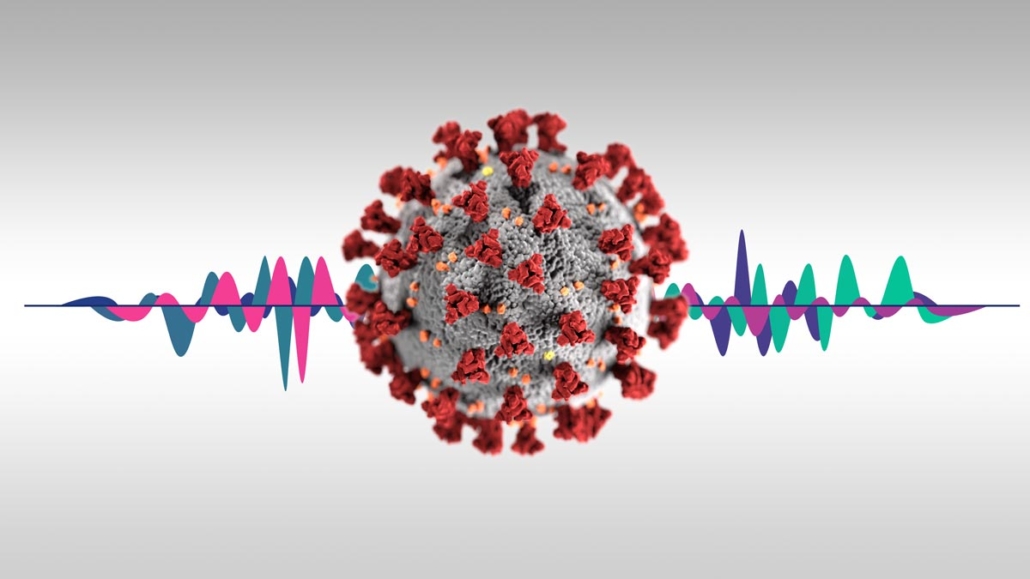
Covid test: voice analysis is more reliable than nasal swabs
Covid can be detected directly by voice using a mobile phone and artificial intelligence.
The confirmation comes from a study conducted by a group of Italian researchers and published at the end of November in the scientific journal Journal of Voice, following the usual peer-review process.
Rapid antigen nasal swabs — commonly available in pharmacies — have a false negative rate of 20–30%, as pointed out a few months ago by Giovanni Maga, virologist and director of the CNR in Pavia. According to research from MIT in Boston, the average accuracy of nasal swabs ranges between 40% and 86%.
Our system reaches 90% accuracy
Explains Giovanni Saggio, professor of electronics at the University of Tor Vergata, speaking to Italian Tech. “And we expect to improve further thanks to machine learning, the automatic learning capability of artificial intelligence.”
Worldwide, at least five or six research groups are exploring voice analysis as a screening tool for various diseases. The Italian study — Machine Learning-Based Voice Assessment for the Detection of Positive and Recovered COVID-19 Patients — is based on a patented system and on collaboration between doctors and specialists from universities such as Tor Vergata and Pavia, as well as hospitals including IRCCS Policlinico San Matteo and Castelli Hospital (ASL Roma 6).
“I don’t like to use the term ‘diagnostic,’” Saggio clarifies. “The algorithm developed by my engineering colleagues and me provides screening results. Diagnosis comes later, thanks to the involvement of specialist doctors in our team, including Professor Antonio Pisani, head of the Research Center for Movement Disorders at the Mondino IRCCS Foundation and full professor of Neurology at the University of Pavia. Our role is to detect vocal anomalies that may indicate whether a person is healthy, infected with COVID, or suffering from long COVID.”
In practical terms
The system analyzes three main domains of the voice: temporal variations, frequency variations, and the distribution of frequencies. Although up to 6,370 acoustic parameters can be examined — including fundamental frequency, harmonics, and signal-to-noise ratio — only about thirty are truly relevant in identifying changes associated with COVID or other pathologies.
Artificial intelligence algorithms extract these key parameters and analyze their relationships. From this, the system calculates a reliable probability of COVID positivity or negativity.
The technology has also shown potential in identifying after-effects in recovered patients. Ultrasound analyses conducted in Padua identified three subgroups among recovered individuals, based on pulmonary fibrosis levels: less than 3%, 20%, and 50% involvement. These fibrotic scars may be reabsorbed over weeks or months. Voice analysis appears capable of detecting differences consistent with these conditions.
But how can a disease affect the voice? The explanation lies in the mechanisms of sound production, which involve the entire respiratory system and muscular components. Just as an experienced ear can distinguish bronchitis from a common cold by the sound of a cough, certain pathologies leave measurable traces in vocal parameters.
Saggio began researching voice analysis in 2009 with Indian colleagues, initially focusing on yellow fever and tuberculosis. Over time, the research expanded to Parkinson’s disease, dysphonia, dysphagia, and now COVID. “Each pathology reflects itself in the voice through specific patterns and through the hierarchical weighting of those thirty key parameters,” he explains. “For example, Parkinson’s does not directly affect the airways, but muscular impairment alters breathing in a recognizable way.”
In the early stages of the study, researchers used professional microphones and controlled environments to obtain high-resolution recordings and identify the most relevant parameters. Later tests showed that recordings made with a standard smartphone were more than adequate.
The procedure is simple
Users sit at home, place their smartphone on a table, read two proverbs, sustain a series of vowels, cough and send the recording.
The original study involved 210 cases, a number that has since quadrupled. “The larger the dataset, the more accurate the system becomes,” says Saggio and the effectiveness of the system relies on combining multiple artificial intelligence algorithms. Machine learning continuously refines performance by correcting errors over time and as for COVID variants, the team is continuing its investigations. “We can already say that the system still works,” Saggio assures. “The only difference is a slight change in the weighting of certain parameters.”
The project has been supported by VoiceWise, a university spin-off founded by Saggio and developed both the web app and the cloud infrastructure used to manage audio files, run AI analysis, and deliver screening results.
All data are encrypted and handled in full compliance with privacy regulations. “Each file is associated with an encrypted alphanumeric code, with no reference to patient identity,” Saggio concludes. An app for Android and iPhone is currently in development, pending CE certification as a medical device.


Lascia un Commento
Vuoi partecipare alla discussione?Sentitevi liberi di contribuire!